

When the Clay Is Cut, a Flower Blooms
The New Beauty Born from Scissors : Yuko Hayashi, Fourth Generation of Koson-gama Kiln
Kyoto’s Kiyomizu ware tradition stretches back centuries, shaped by generations of potters who refined both technique and aesthetic ensibility. Located along Chawan-zaka, the historic slope leading to Kiyomizu Temple where pottery workshops have long flourished, Koson-gama kiln has continued its craft for more than a hundred years. Today, its legacy is guided by fourth-generation potter Yuko Hayashi, who has both inherited and reinvented the family tradition.
Koson-gama’s story begins in 1915, when the founder Eijiro Hayashi moved from Gifu Prefecture to Kyoto and established the kiln along the Kiyomizu temple approach. At that time, he focused primarily on celadon, producing refined works that were widely exported overseas before World War II. His son Enzan Hayashi continued the family craft, and after the war he renamed the kiln Koson.
Under Enzan’s leadership, the workshop developed distinctive styles of white porcelain and celadon, refining their forms and colors while maintaining the elegance associated with Kyoto ceramics. The kiln’s aesthetic continued to evolve with the third generation, Katsuyuki Hayashi, who pursued a particularly restrained and refined approach. Through decades of experimentation with clay composition, glaze, and form, Koson-gama developed ceramics that are striking in their simplicity. Rather than elaborate decoration, the beauty of these works emerges from subtle surfaces, quiet color, and refined silhouettes.
The kiln is equally known for its celadon. Drawing inspiration from the rich green glazes perfected during China’s Song dynasty, Enzan Hayashi refined traditional methods to produce a glaze of unusual depth and softness. The resulting celadon carries a quiet, velvety tone—deep yet gentle—that has become a hallmark of Koson-gama’s work.
Into this lineage of technical mastery and understated beauty stepped Yuko Hayashi, the kiln’s fourth-generation successor. Born and raised in the workshop, she grew up surrounded by both craftsmanship and creativity: her father a ceramic artist, her mother a textile designer. Their home stood on Chawan-zaka, where artisans and merchants have long shaped Kyoto’s cultural life.
When Yuko was in middle school, her mother passed away. Wanting to follow in her creative footsteps, she studied Nihonga (Japanese-style painting) at an art-focused high school. Yet despite growing up in the kiln, she did not immediately choose pottery as a career. After graduation she entered the fashion industry, working for an apparel company and finding satisfaction in design and retail.
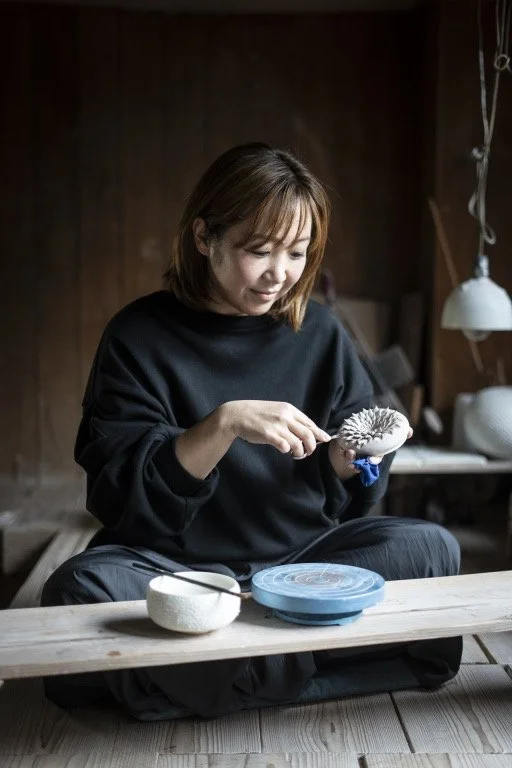
However, the changing business climate eventually forced many stores to close, prompting Yuko to reconsider her path. Around that time, her father asked a simple question: “Why not try ceramics?”Unable to refuse, she enrolled in a ceramics school and began learning the technical foundations of the craft. Working closely with her father, she mastered Koson-gama’s traditional methods. But as her skills developed, so too did a desire to express something distinctly her own.
In today’s world, beautifully designed tableware can be mass-produced and purchased at relatively low cost. Yuko felt strongly that the deeper value of handcrafted ceramics—the presence of the maker’s hand and the spirit of tradition—needed to be communicated more clearly. Searching for a new visual language that could convey this vitality, she experimented with form, texture, and surface decoration.
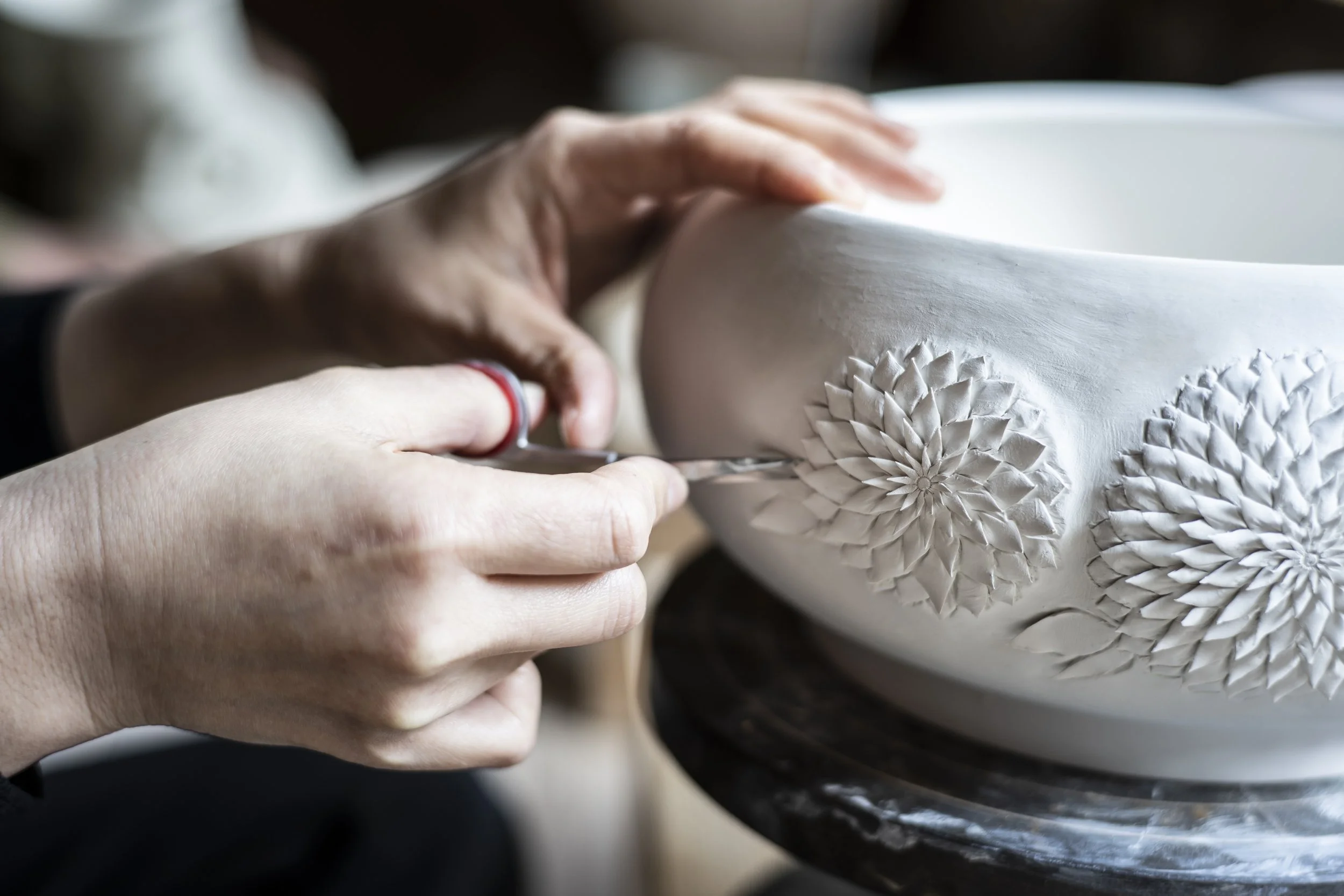
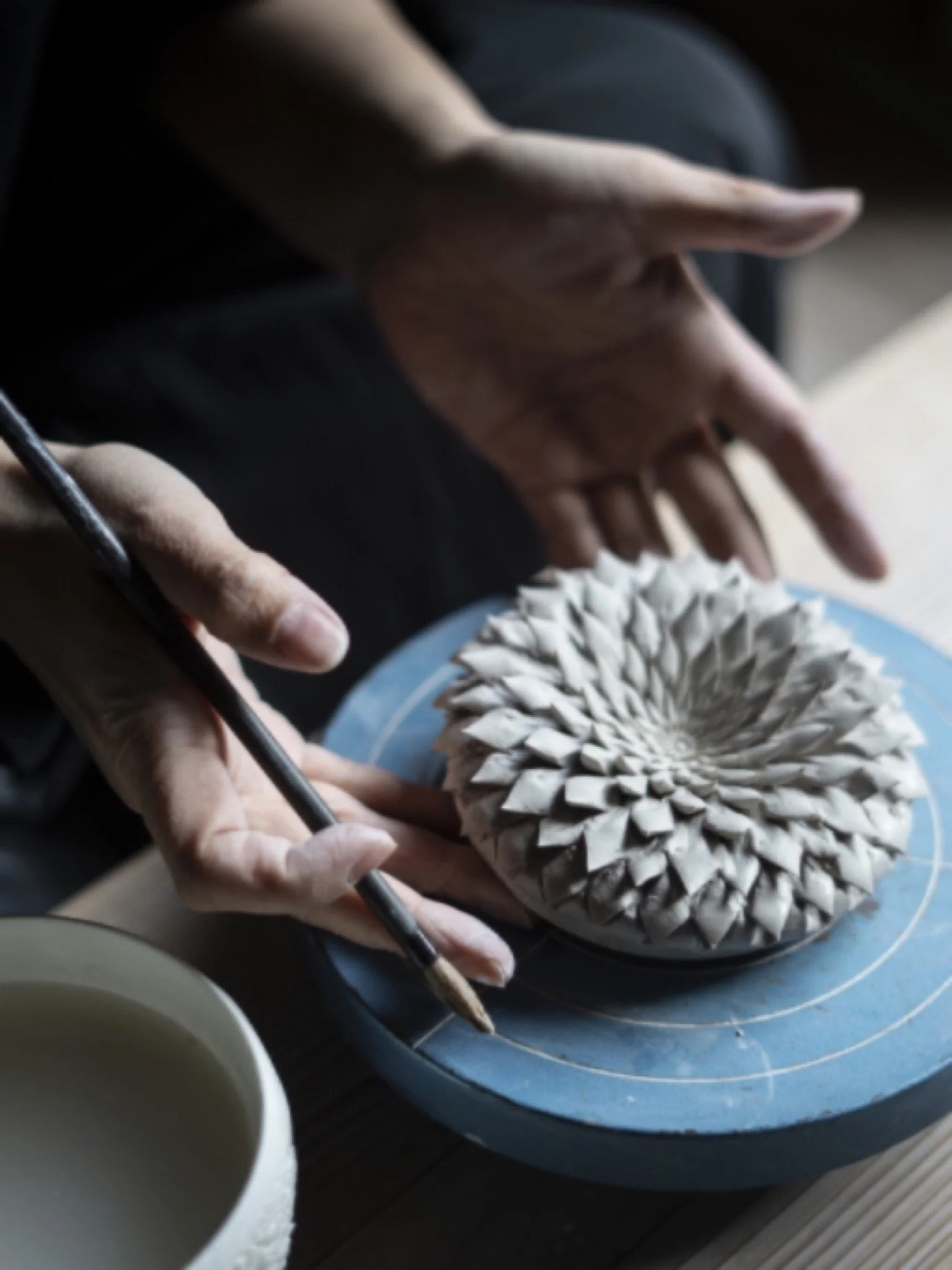
The breakthrough came in 2016 with a technique she calls “Tsuchi-basami”, literally “clay scissors.” The idea was inspired by hasami-giku, a decorative method used in Japanese confectionery to shape delicate chrysanthemum petals from sweet bean paste. Yuko adapted this concept to ceramics. After forming a vessel, she moistens the surface and uses carefully sharpened scissors to make countless small cuts in the soft clay. Each incision lifts slightly as the blades withdraw, gradually creating threedimensional patterns.
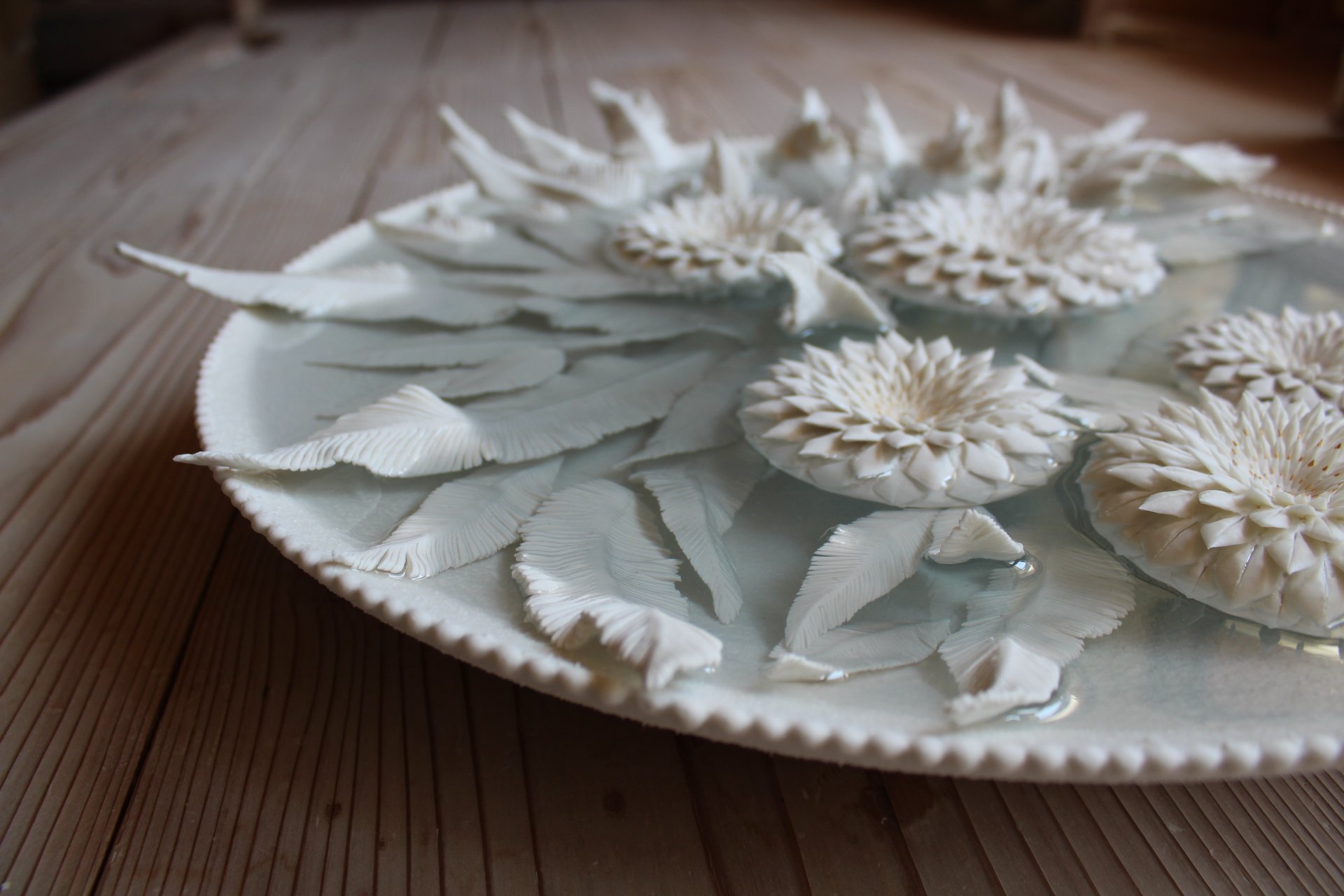
The process must be repeated thousands of times. Flowers bloom across the surface of a bowl or vase; fish scales shimmer along a curved form; leaves or feathers appear as if emerging from within the clay itself. The technique demands a precise understanding of the clay’s condition—too wet and the shape collapses, too dry and the scissors cannot cut cleanly.
Only by judging the perfect moment can the motif emerge gracefully. Combined with the kiln’s distinctive clay formulas, traditional aesthetics, and inherited craftsmanship, Tsuchi-basami forms a natural extension of the workshop’s history. With each careful cut, a flower blooms. And with it, a century-old kiln finds its path into the future.
Koson-gama 紅村窯
The shop is located on Chawan-zaka street leading to Kiyomizu Temple; A 10-min. walk from Kyoto City Bus #206, Gojo-zaka Stop; 11:00-17:00 (closed Mon. & Fri.); https://koson.jp